Blog·Case Study

Mem0 vs Supermemory: Why Scira Switched

Scira AI moved its production memory layer from Mem0 to Supermemory. This is what failed, what improved, and how the team evaluated the two systems.
By Dhravya Shah·5 min read

Supermemory header reading "Scira switched its memory layer to Supermemory" — A notebook, source cards and a magnifying glass represent saved research

Scira moved its production memory workload from Mem0 to Supermemory after evaluating indexing, retrieval and integration in its research product. Here is what the team reported and what other teams can test before a similar move.

The short answer is that Mem0 and Supermemory can both store and retrieve memories, but they make different tradeoffs around the rest of the context stack. Mem0 exposes memory primitives through its hosted platform and open-source project. The hosted Supermemory platform combines ingestion, retrieval, versioned memories, profiles, and managed connectors behind one API.

That distinction only matters when it changes what your users experience. For Scira AI, it did.

Why did Scira compare Mem0 and Supermemory?

Scira is an open-source AI search product. Its users run research queries, return to earlier work, and bring their own notes and documents into new conversations. Memory is not a decorative feature in that workflow. If indexing silently fails or retrieval arrives late, the product feels broken.

Founder Zaid Mukaddam described the team's Mem0 experience plainly: “Mem0 was not great. Glad to have found Supermemory.”

The problems Scira reported were operational rather than theoretical:

  • memories did not always appear after indexing
  • retrieval latency interrupted the research flow
  • earlier context sometimes failed to return
  • the connectors Scira needed were not usable for its workflow
  • debugging the memory layer was consuming product time

For Scira, those failures interrupted the research workflow and made memory a recurring operating problem.

What changed after Scira switched?

Scira moved the memory workload to Supermemory and kept the product experience intact. Zaid described the APIs as straightforward, and the team was able to test the replacement without turning the migration into a rewrite.

After the switch, Scira reported reliable indexing, lower retrieval latency, working data imports, and fast support when issues appeared. Memory stopped being the weakest part of the product.

The product result was useful too: Scira reported roughly 32% usage growth after launching the improved memory experience, and ten pro researchers signed up specifically for memory. Those numbers belong to one customer and should not be treated as a forecast. They do show why infrastructure quality matters: users notice when an agent can pick up where they left off.

How do Mem0 and Supermemory differ?

Both products are moving quickly, so a feature checklist will age. The more durable comparison is which parts of the system your team wants to own.

Area Mem0 Supermemory
Core model Memory APIs with hosted and open-source deployment options, including graph memory Managed context infrastructure plus a local edition with a different feature set
Ingestion Add conversations, text, and supported files through SDKs and APIs Add text, URLs, files, conversations, or direct memories through one API's dedicated endpoints
Retrieval Hybrid memory search with semantic, keyword, and built-in entity/graph signals Search memories, document chunks, or both; retrieve profiles through a separate API
Memory lifecycle CRUD, history, filters, and structured exports Versioned updates, explicit forgetting, profiles, and document-to-memory provenance
Operational tradeoff More control when you want to assemble or host the stack yourself Less integration work when you want the memory and context layers managed together

Scira's decision came down to the indexing, retrieval and connector behavior its users needed. Compare those same requirements in the deployment you plan to run.

Supermemory is a stronger fit when you want one surface for ingestion, recall, profiles, and memory lifecycle management. Include the surrounding integration and maintenance work when comparing the two options.

How should teams compare memory quality?

A memory system should do more than return text that looks related. It should handle updates, contradictions, stale facts, and the boundary between one user's context and another's.
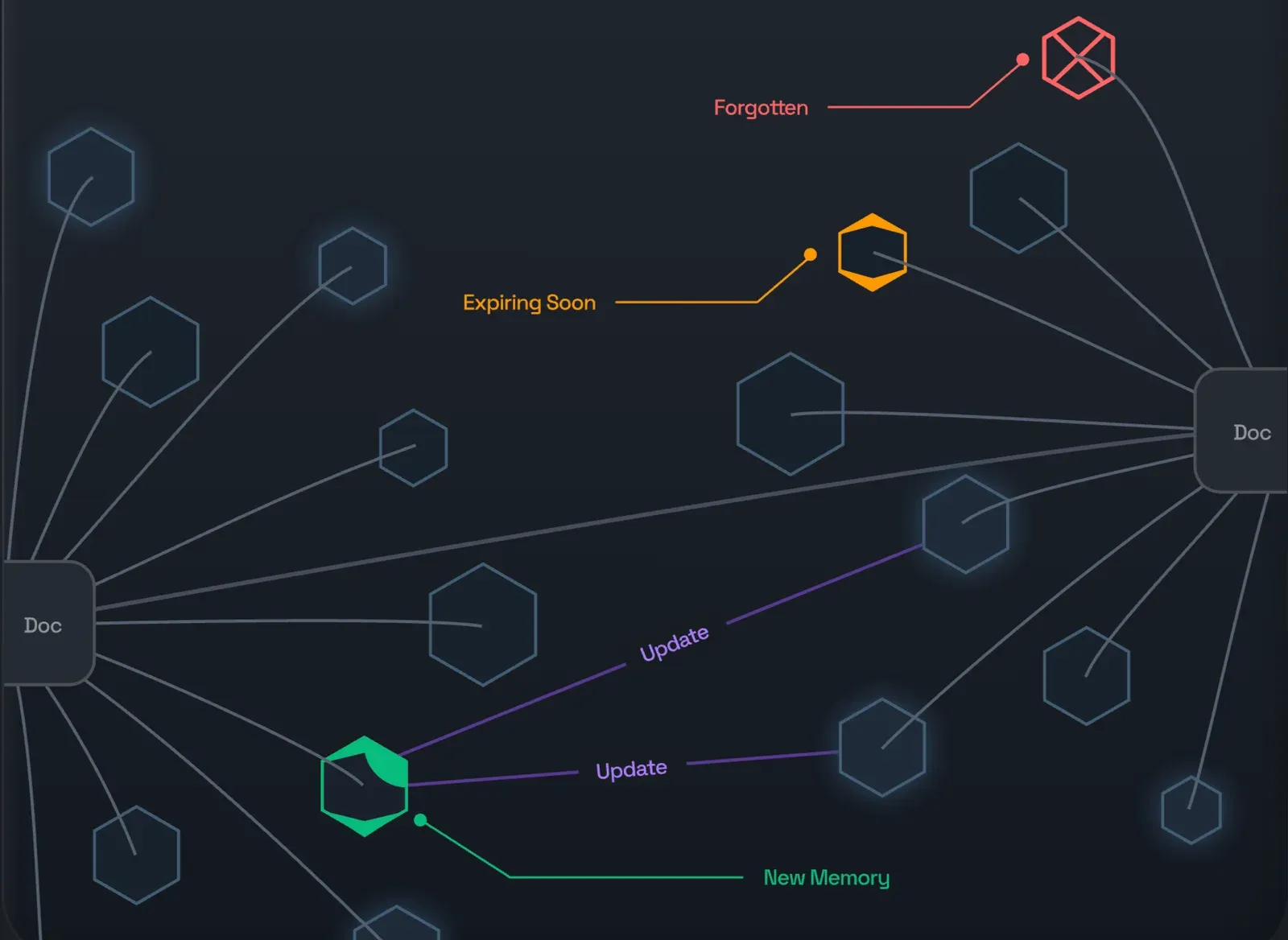
A memory graph showing forgotten, expiring, updated, and newly inferred memories

How should you evaluate a Mem0 alternative?

Start with a small evaluation set from production. Twenty carefully chosen conversations are more useful than a thousand synthetic questions if those twenty represent the failures your users actually report.

Measure these separately:

  1. Recall quality. Did the system return the fact needed to answer the question?
  2. Precision. Did it avoid plausible but irrelevant memories?
  3. Freshness. When a fact changed, did the newer version win?
  4. Latency. Record p50 and p95 across the complete request, not a warm local demo.
  5. Ingestion reliability. Verify that every accepted item becomes searchable and that failures are observable.
  6. Isolation. Test that user, agent, and workspace boundaries hold under adversarial queries.
  7. Operational load. Count the pipelines, queues, databases, and evaluation code your team must maintain around the service.

Do not pick a memory provider from a homepage comparison. Run both systems against the same data, the same questions, and the same success criteria.

How do you migrate from Mem0 safely?

A migration should stay reversible until the replacement has earned production traffic. The implementation details—identity mapping, backfill, dual writes, shadow reads, cutover, and rollback—live in the separate Mem0 to Supermemory migration playbook.

Which one should you choose?

Choose Mem0 if you want its open-source ecosystem, prefer to compose the surrounding infrastructure yourself, and its behavior meets your workload's quality and latency targets.

Choose Supermemory if you want the context stack behind one API, need documents and memories to work together, or do not want memory infrastructure to become a separate product inside your company.

Scira made that choice after testing both in a live product. You should do the same. Start with the Supermemory quickstart, run a narrow evaluation, and let your own workload decide.

Frequently asked questions

Why did Scira AI switch from Mem0 to Supermemory?

Scira reported slow retrieval, unreliable indexing, weak recall, and unusable connectors in its Mem0 deployment. After moving to Supermemory, the team reported more reliable indexing, lower latency, working connectors, and faster support.

What should teams test when comparing Mem0 and Supermemory?

Test recall quality on real user questions, p50 and p95 latency, ingestion reliability, contradiction handling, tenant isolation, observability, exportability, and the engineering work required around the memory service.

  1. We're open sourcing the company brain. Here's how we designed the multiplayer harnessCompany Brain is now open source. A walkthrough of the multiplayer harness behind its Slack experience, from proactivity and memory boundaries to approvals and recovery.
  2. Jev changes a lot in memory & context engineering. Here's exactly how.We tested Jev across reranking, chunking, observation, and harness decisions. Here is where fast decision models help memory systems, where they cost more, and where they still fall short.
  3. I reverse-engineered Instinct's memory. Here's exactly how it worksInstinct keeps its memory as git-tracked markdown files, found with grep rather than vectors. Here is the whole system as far as black-box probing can reconstruct it, and how to rebuild it on supermemory in about 60 lines.
  4. An update to supermemoryWe've discontinued the supermemory company brain and Nova. Everyone who was charged has been refunded, our MCP and plugins continue to run, and we're going all in on the memory engine.
  5. Scaling Conversations: How Adapta Grew Usage Without Losing ContextAdapta added Supermemory as a persistent memory layer so every conversation keeps its context — letting the team scale usage without losing the thread.
  6. How Chatarmin Ditched RAG and Went Memory-Only with SupermemoryChatarmin replaced a heavy RAG pipeline with Supermemory's memory layer — cutting average AI response time from 40s to 12s and token usage by 40–50%.
  7. SMFS: making agentic retrieval 55% cheaper AND more accurateWe launched SMFS.ai (Supermemory Filesystem) a few weeks ago, with a simple bet: We can redesign the filesystem specifically for agents, with special files, structures, and commands that it can use for it's tasks. Today, SMFS is used by hundreds of companies to power their agents.
  8. Introducing Dynamic Dreaming: supermemory now connects the dots, for you.Dreaming is magical. TLDR: We're launching Dynamic Dreaming in supermemory today, which automatically works if you're using supermemory in any way - API, OpenClaw, Hermes agent, etc.
  9. Dear reader, we just made supermemory insanely cheap... the Context CloudWhen I first started building supermemory, I had one goal: To build the best memory system for AI. I would talk to customers, and find out that memory was not the only thing they needed - They were all setting up 7-8 different vendors at the same time.
  10. Introducing @supermemory/tools v2.0.0Today we're releasing v2.0.0. This release unifies the API across all agents sdk integrations from AI SDK to Mastra, makes conversation identity a first-class concept, and ships with memory saving on by default.
  11. Solving the Precision-Recall Tradeoff: Search Result AggregationWhen you're building memory for AI, search is your foundational layer. The way search generally works is straightforward: the user defines a query, and then sets a limit (top-K) on how many search results they want returned. Usually, this is set to 10 or 20.
  12. OpenClaw Memory Problems: Why It Forgets and How to Fix It (2026)TLDR: Today, we are releasing a new version of our openclaw plugin - https://github.com/supermemoryai/openclaw-supermemory. This post is going to be a bit technical, so bear with me (or bookmark for later!) In this post, I will talk about what we do about OpenClaw memory, and how we fix it.
  13. Stateful Coding Agents with Memory: Build Long-Running Agents (2026)We built a plugin for Claude Code and OpenCode that gives your coding agent persistent memory. It remembers your preferences, learns your codebase, and never loses context mid-conversation. The result is an agent you can run for months without starting over.
  14. Clawd / Molt bot's memory SUCKS. We gave it supermemory.I'm the founder of supermemory. Clawd/Molt bot is blowing up right now, with many, many use cases. I set it up, too, and have been using it through telegram. TLDR: just go to https://supermemory.ai/docs/integrations/clawdbot to set up supermemory for your clawd bot.
  15. Catch up with our UNFORGETTABLE Launch WeekOver the last year, one belief has guided almost everything we’ve built at Supermemory AI becomes meaningfully useful only when it remembers. Memory shouldn’t be something developers rebuild from scratch. It shouldn’t be fragile, expensive, or trapped inside a single tool.
  16. Empowering the Next Generation of Founders: Supermemory Startup ProgramIf there’s one thing we’ve learned while building Supermemory, it’s that most startups don’t fail because they didn't build features; they fail when infrastructure slows them down, or they built too slow.
  17. Building code-chunk: AST Aware Code ChunkingAt Supermemory, we're building context engineering infrastructure for AI. A huge part of that is dealing with code: ingesting repos, understanding structure, and making it searchable. The problem is that most code chunking solutions are terrible. We built code-chunk to fix this.
  18. Supermemory raises $3 million with the best memory engine for LLMsToday, I am excited to announce our first funding round to accelerate our mission of building an interoperable, scalable and reliable memory for LLMs and agents. Memory is one of the hardest challenges in AI right now.
  19. Never Record Again: How Montra Uses Supermemory to Rethink Video CreationCampbell Baron, the founder of Montra, has been making videos since he was twelve. By thirteen, he was already doing brand work. Today, he’s betting on a very different future for creators: a world where recording is the exception, and most videos are generated from scratch.
  20. Unified Memory That Works Where You Work: Your Second Brain With SupermemoryHi everyone, I’m Dhravya, the founder of Supermemory. I want to start with a little story behind why this product means so much to me. You can also skip straight to what it is and how it works below.
  21. Supermemory just got faster on PlanetScaleWhat is Supermemory? Supermemory completes the missing part of the LLM puzzle: memory. Just as memory is crucial for human intelligence, it's essential for truly intelligent AI systems.
  22. Faster, smarter, reliable infinite chat: Supermemory IS context engineering.People are obsessed with prompts and prompt engineering. Sure, what you say is important, but what the model knows when you say it is the difference between a stateless text generator and an intelligent AI system. In short, context is the most crucial component.
  23. We solved AI API interoperabilityOne API to rule them all, One spec to find them, One library to bring them all and in the TypeScript, bind them. When we were building the Infinite Chat API, initially, we only supported the OpenAI format. This was fine, until a lot of our customers started asking for more.
  24. The Wow Factor of Memory - How Flow Used Supermemory To Build Smarter, Stickier ProductsOverview: Flow is a note-taking app built around a bold vision: to create a more personal, context-aware writing experience powered by AI. At the heart of this mission is memory.
  25. The UX and technicalities of awesome MCPsLast month, we launched the Supermemory MCP, mostly to test our own infrastructure and get some initial traction. It blew up. To my absolute surprise, the initial launch itself got half a million impressions (!!!). Then, we launched and got #2 on ProductHunt too.
  26. Architecting a memory engine inspired by the human brainLanguage is at the heart of intelligence, but what truly powers meaningful interaction is memory — the ability to accumulate, recall, and contextualize information over time. Large Language Models (LLMs) have mastered language, but memory remains their Achilles’ heel.
YOUR PRIVACY

Change or withdraw any time via Cookie settings in the footer. Read our cookie notice.