Blog·News

Faster, smarter, reliable infinite chat: Supermemory IS context engineering.
By Dhravya Shah·3 min read

Banner reading "Faster, Smarter, Reliable Infinite Chat" with a blue infinity-loop chat icon and Supermemory logo

People are obsessed with prompts and prompt engineering. Sure, what you say is important, but what the model knows when you say it is the difference between a stateless text generator and an intelligent AI system.

In short, context is the most crucial component. Karpathy’s viral tweet called it out:

We thought to ourselves: our current infinite chat is context engineering! However, it had its fair share of issues. It didn’t work with all AI providers like Gemini and Anthropic, couldn’t support multi-modal memory, didn’t have tool call support, and more.

So, we fixed it.

With today’s release, our Infinite Chat becomes a full-blown context engineering engine.

The TL;DR is: it’s faster, smarter, and more reliable.

Here’s everything that’s new:

  • Multi-modal memory support (images, audio, structured data, etc.)
  • Works with all LLMs like Gemini and Anthropic, not just OpenAI.
  • Tool calls awareness and memory
  • Higher context limits
  • Long-context RAG
  • Implicit few-shot learning
  • Smarter summarization and pruning to avoid context pollution
  • A new architecture for better reliability and response quality
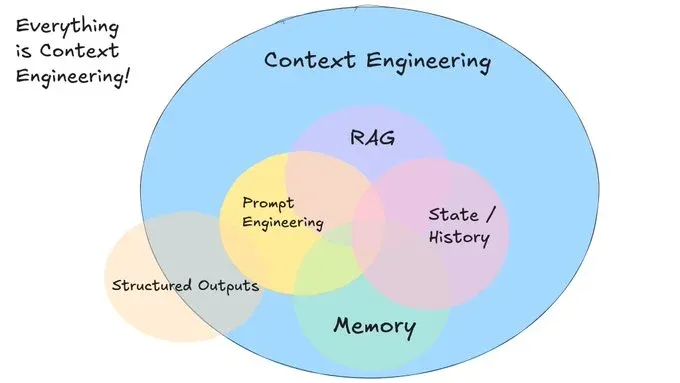
Venn diagram: Context Engineering enclosing RAG, Prompt Engineering, State/History, Memory, and Structured Outputs
Source

Multi-step agent support

Agents are a bit messy. Sometimes, they stop mid-task and need to pick up where they left off, without getting confused or forgetting everything.

Say you're building a coding co-pilot. You tell it: “Edit 100 files and add 1 new feature.”

It gets through 50, then the call times out or the model hits a limit. Now what? All 50 interactions would be polluting the context.

Our new infrastructure solves it.

If you provide the conversation-id, Infinite Chat removes the unnecessary context and automatically backfills it, making the network requests much faster, even on extremely long contexts:

// if you provide conversation ID, You do not need to send all the messages every single time. Supermemory automatically backfills it. 
const client = new OpenAI({
    baseURL:
"https://api.supermemory.ai/v3/https://api.openai.com/v1",
    defaultHeaders: {
        "x-supermemory-api-key":
            "",
        "x-sm-user-id": `dhravya`,
        "x-sm-conversation-id": "conversation-id"
    },
})

const messages = [
{"role" : "user", "text": "SOme long thing"},
// .... 50 other messages
{"role" : "user", "text": "new message"},
]

const client.generateText(messages)

// Next time, you dont need to send more.
const messages2 = [{"role" : "user", "text": "What did we talk about in this conversation, and the one we did last year?"}]

const client.generateText(messages2)

That includes:

  • A summary of what was done. For instance, “50 files were changed to add feature XYZ.”
  • A diff of what’s pending: “These 12 are still left.”
  • And even implicit few-shot grounding from earlier turns: “Here’s how you’ve answered similar requests before.”

It’s also cheaper, cleaner, and easier to reason about than long chat dumps.

Works with all LLM providers

Initially, Infinite Chat only supported the OpenAI API format. But, our customers asked for more - Gemini, Anthropic, Langchain, AI SDK, etc.

It was a pain in the ass to implement a system with multiple different providers, each provider having different ways to do multi-modal, tool call chains, calculating token counts, etc. for all their different models.

So, we built llm-bridge, an open-source package, to solve this issue, and used it in Infinite Chat. This makes adoption seamless: all you have to do as a developer is prepend your provider's base URL with our API's URL, add your Supermemory API key, and we take care of the rest. That is, there is no change to the client interface. You can keep using your SDK of choice no matter what!

const client = new OpenAI({
    baseURL:
"https://api.supermemory.ai/v3/https://api.openai.com/v1",
    defaultHeaders: {
        "x-supermemory-api-key":
            "",
        "x-sm-user-id": `dhravya`,
    },
})
/// or new Anthropic() or new GoogleGenAI()

Read about it in more detail here.

Smarter Memory Management

Beyond simple message history, the new Infinite Chat lets your models remember more than just words and do more with them.

This includes:

  • Multimodal memory: Images, audio, structured data, etc. Anything your agent sees can now persist across calls. A screenshot sent two messages ago? Still in context. A chart from last week? Still referenced.
  • Tool call tracking: We store tool invocations and outputs as first-class context objects. The model knows what tools it has used, what the results were, and doesn’t blindly repeat actions.
  • Long-context RAG: Instead of stuffing 10 retrieved passages into every prompt, Supermemory now decides what’s already been seen, summarizes it when needed, and surfaces only new or relevant chunks.

In essence, we’ve taken Karpathy’s point seriously:

"Context engineering is the delicate art and science of filling the context window with just the right information for the next step."

What you really want is:

  • Just enough memory to make the next decision smart
  • Just enough pruning to keep token usage efficient
  • Just enough scaffolding to avoid re-teaching the model what it already knows

That’s what the new Infinite Chat does.

Take it out for a spin today!
  1. An update to supermemoryWe've discontinued the supermemory company brain and Nova. Everyone who was charged has been refunded, our MCP and plugins continue to run, and we're going all in on the memory engine.
  2. SMFS: making agentic retrieval 55% cheaper AND more accurateWe launched SMFS.ai (Supermemory Filesystem) a few weeks ago, with a simple bet: We can redesign the filesystem specifically for agents, with special files, structures, and commands that it can use for it's tasks. Today, SMFS is used by hundreds of companies to power their agents.
  3. Introducing Dynamic Dreaming: supermemory now connects the dots, for you.Dreaming is magical. TLDR: We're launching Dynamic Dreaming in supermemory today, which automatically works if you're using supermemory in any way - API, OpenClaw, Hermes agent, etc.
  4. Dear reader, we just made supermemory insanely cheap... the Context CloudWhen I first started building supermemory, I had one goal: To build the best memory system for AI. I would talk to customers, and find out that memory was not the only thing they needed - They were all setting up 7-8 different vendors at the same time.
  5. Introducing @supermemory/tools v2.0.0Today we're releasing v2.0.0. This release unifies the API across all agents sdk integrations from AI SDK to Mastra, makes conversation identity a first-class concept, and ships with memory saving on by default.
  6. supermemory will make your Hermes-agent crazy powerfulToday, we are launching supermemory support to your Hermes agent TLDR: you can use supermemory now in your Hermes agent, it totally free to get started - https://supermemory.ai/docs/integrations/hermes In case you missed it: Hermes Agent is a self-improving AI agent from Nous Research.
  7. Solving the Precision-Recall Tradeoff: Search Result AggregationWhen you're building memory for AI, search is your foundational layer. The way search generally works is straightforward: the user defines a query, and then sets a limit (top-K) on how many search results they want returned. Usually, this is set to 10 or 20.
  8. Infinitely running stateful coding agentsWe built a plugin for Claude Code and OpenCode that gives your coding agent persistent memory. It remembers your preferences, learns your codebase, and never loses context mid-conversation. The result is an agent you can run for months without starting over.
  9. Why everyone is complaining about OpenClaw's memory (it sucks) - and why supermemory fixes it.TLDR: Today, we are releasing a new version of our openclaw plugin - https://github.com/supermemoryai/openclaw-supermemory. This post is going to be a bit technical, so bear with me (or bookmark for later!) In this post, I will talk about what we do about OpenClaw memory, and how we fix it.
  10. We added supermemory to Claude Code. It's INSANELY powerful now...Today, we are launching the Supermemory plugin for Claude Code! TLDR: You can use supermemory in claude code now. - https://github.com/supermemoryai/claude-supermemory Claude code has genuinely changed how I work. But there's this one thing that drives me crazy...
  11. Clawd / Molt bot's memory SUCKS. We gave it supermemory.I'm the founder of supermemory. Clawd/Molt bot is blowing up right now, with many, many use cases. I set it up, too, and have been using it through telegram. TLDR: just go to https://supermemory.ai/docs/integrations/clawdbot to set up supermemory for your clawd bot.
  12. Catch up with our UNFORGETTABLE Launch WeekOver the last year, one belief has guided almost everything we’ve built at Supermemory AI becomes meaningfully useful only when it remembers. Memory shouldn’t be something developers rebuild from scratch. It shouldn’t be fragile, expensive, or trapped inside a single tool.
  13. Empowering the Next Generation of Founders: Supermemory Startup ProgramIf there’s one thing we’ve learned while building Supermemory, it’s that most startups don’t fail because they didn't build features; they fail when infrastructure slows them down, or they built too slow.
  14. Building code-chunk: AST Aware Code ChunkingAt Supermemory, we're building context engineering infrastructure for AI. A huge part of that is dealing with code: ingesting repos, understanding structure, and making it searchable. The problem is that most code chunking solutions are terrible. We built code-chunk to fix this.
  15. Supermemory raises $3 million with the best memory engine for LLMsToday, I am excited to announce our first funding round to accelerate our mission of building an interoperable, scalable and reliable memory for LLMs and agents. Memory is one of the hardest challenges in AI right now.
  16. Unified Memory That Works Where You Work: Your Second Brain With SupermemoryHi everyone, I’m Dhravya, the founder of Supermemory. I want to start with a little story behind why this product means so much to me. You can also skip straight to what it is and how it works below.
  17. Supermemory just got faster on PlanetScaleWhat is Supermemory? Supermemory completes the missing part of the LLM puzzle: memory. Just as memory is crucial for human intelligence, it's essential for truly intelligent AI systems.
  18. We solved AI API interoperabilityOne API to rule them all, One spec to find them, One library to bring them all and in the TypeScript, bind them. When we were building the the Infinite Chat API, initially, we only supported the OpenAI format. This was fine, until a lot of our customers started asking, asking for more.
  19. The UX and technicalities of awesome MCPsLast month, we launched the Supermemory MCP, mostly to test our own infrastructure and get some initial traction. It blew up. To my absolute surprise, the initial launch itself got half a million impressions (!!!). Then, we launched and got #2 on ProductHunt too.
  20. Architecting a memory engine inspired by the human brainLanguage is at the heart of intelligence, but what truly powers meaningful interaction is memory — the ability to accumulate, recall, and contextualize information over time. Large Language Models (LLMs) have mastered language, but memory remains their Achilles’ heel.