Blog·Engineering

SMFS: making agentic retrieval 55% cheaper AND more accurate
By Dhravya Shah·4 min read

Banner with white serif text "smfs. | eval" over a painted classical landscape of Greek temples and columns

We launched SMFS.ai (Supermemory Filesystem) a few weeks ago, with a simple bet: We can redesign the filesystem specifically for agents, with special files, structures, and commands that it can use for it's tasks. Today, SMFS is used by hundreds of companies to power their agents.

TL;DR
You can read the report here - smfs.ai/research/memory-as-a-filesystem

If you missed that launch, here's a quick summary of SMFS:

  • Agentic Filesystem powered by FUSE that loads instantly.
  • /profile.md auto-generated and updated based on content in the filesystem.
  • Multi-modal data (images, etc) can be grepped through, as SMFS runs OCR stores them as text files
  • Grep and some other commands are replaced to give the agent an option to do semantic search as well.

All of that, built into a true filesystem - that the agent can use and navigate.

It was time for us to run some benchmarks!

In this blog, I'll go over some of the intuition and introduce the things we did to fix them.

The problems

Two halves, each broken on its own.

Agentic search is what every coding agent already does: list a directory, cat a few files, grep for a string, reason, repeat. It's powerful because the agent stays in control. It's kinda like having a stack of books in front of you - without a title. In order to find a specific thing, you'll have to open the books, remember which had what, and then skim through each page to get something, holding all that traversal in your "context window"

Semantic retrieval, RAG-style, SHOULD fix exactly that. One query pulls content by meaning, surfacing passages no grep could locate. But it hands back a top-K list of chunks ripped out of context: excerpts with no neighbors, no surrounding file, no thread to pull. The agent gets an answer fragment and nowhere to stand. Multi-hop reasoning suffers worst, because the next question depends on context the chunk threw away.

Our users were always stuck choosing. Agentic search gives structure and control but can't find things at scale. File search finds things but severs them from the structure the agent needs to reason. Pick one and you've picked your failure mode.

The whole point is: you shouldn't have to pick.

Figure 1 · xAFS cost curve

Per-question token cost vs. corpus size

fs-onlySMFS
00.25M0.5M0.75M1M1.25M1.5M1.75M2M5102030501002002994809911,9984,9989,988299 files: fs-only thrashes1.54M/q · $20.95 vs $4.719,988 files: SMFS pass ratemeets fs (81% vs 69%)Corpus size (files, log scale)Avg tokens per question
Per-question token cost across 5 to 9,988 files (log scale). fs-only grows ~7× over the range; SMFS grows ~4×. The 299-file corpus is a notable outlier where fs-only thrashes. n = 220 (fs) + 220 (smfs) trials · smfs.ai/research/runs

The bottleneck of agent memory was never the speed of a single retrieval. It's the number of retrievals an agent issues before it has enough context to answer - every one of them inflating the context window with paths, partial reads, and overlapping chunks until reasoning degrades.

Agentic search inflates that count by exploring blindly. File search inflates it by making the agent re-search for the context each chunk is missing.

Combine them and the count collapses. Semantic search lands on a path. The agent reads the surrounding file, follows the thread, greps the subtree, agentically, from a starting point it actually trusts. You get the reach of file search and the control of agentic search in the same motion. That's the bet. That's the north star.

Introducing xAFS

To measure and test the quality of SMFS, we needed a realistic benchmark with:

  • Both conversational and document data (Memory + Filesystem)
  • Gradually increasing number of files (So we can determine the curve of change)
  • Non-Needle-in-haystack questions that test for multi-hop, temporal and other types of queries
  • Each file being more than 10k tokens
  • Testing upto 10k Files, all of them being one coherent "Story" with coherent facts

There was no benchmark for agentic search specifically on the internet - so, we created one.

This benchmark is specifically made for agentic retrieval, and extendable for any use cases! We invite people to come and try it out huggingface.co/datasets/supermemory/xAFS

How SMFS performed

SMFS results were truly staggering. At 10,000 files, the standard filesystem agent's accuracy collapses to 69%. Ours holds at 81%.

Total bill across the whole eval: $2,103 vs $946. 55% cheaper.

On one corpus the baseline thrashed to $20.95 per question. Ours answered the same question for $4.71.

53.8% fewer tokens. 53.1% fewer tokens per _correct_ answer.

Claude's harness used −66% tokens, and −60% tool calls — and it got more accurate.All the evaluation runs are publicly available at smfs.ai/research/runs, where each run can be inspected. Here's a run where smfs used 50% less tokens, latency and cost:
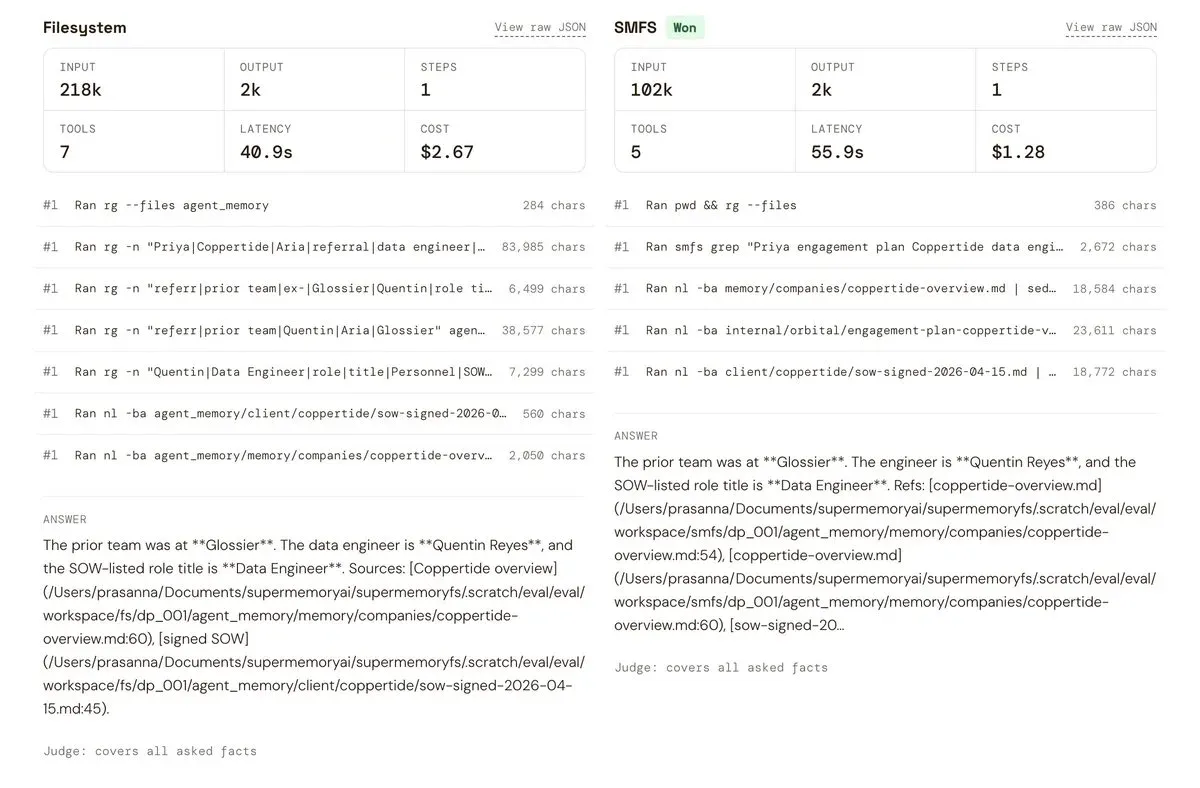
Side-by-side eval comparing Filesystem (218k tokens, $2.67) versus SMFS (182k tokens, $1.28) on the same agent task

Work doesn't end here

We have published a detailed report about SMFS - How it has a sync engine, Profiles, using Grep as retrieval, and all the other thought we put in, in a technical report here - smfs.ai/research/memory-as-a-filesystem
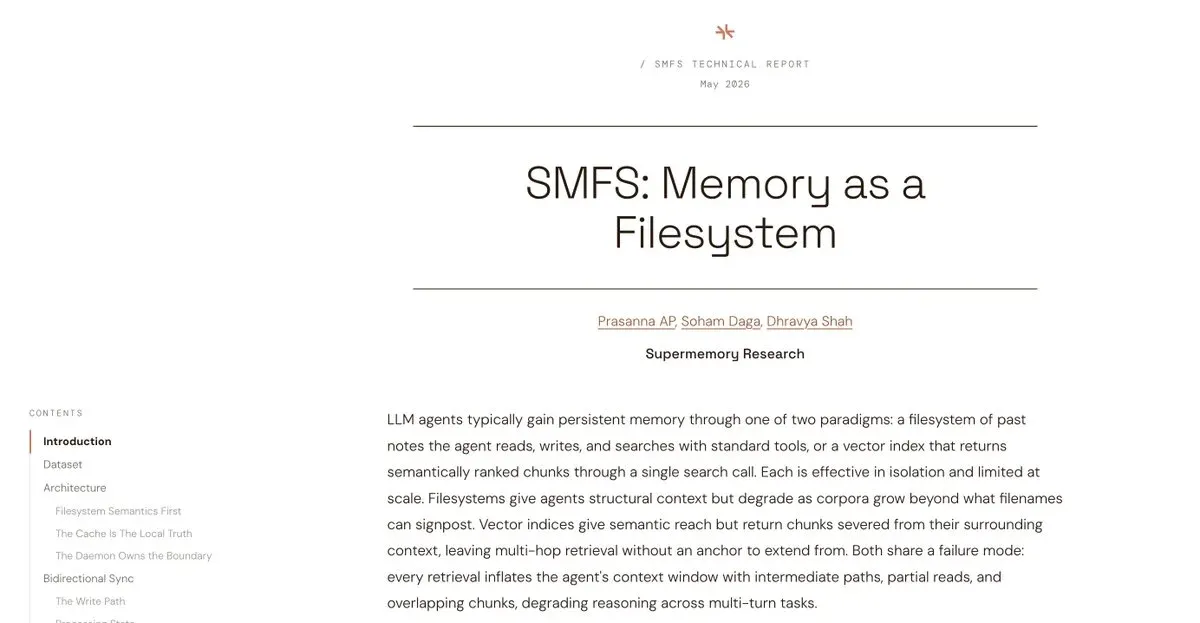
Title page of the "SMFS: Memory as a Filesystem" technical report by Supermemory Research
  1. Introducing Dynamic Dreaming: supermemory now connects the dots, for you.Dreaming is magical. TLDR: We're launching Dynamic Dreaming in supermemory today, which automatically works if you're using supermemory in any way - API, OpenClaw, Hermes agent, etc.
  2. Dear reader, we just made supermemory insanely cheap... the Context CloudWhen I first started building supermemory, I had one goal: To build the best memory system for AI. I would talk to customers, and find out that memory was not the only thing they needed - They were all setting up 7-8 different vendors at the same time.
  3. Introducing @supermemory/tools v2.0.0Today we're releasing v2.0.0. This release unifies the API across all agents sdk integrations from AI SDK to Mastra, makes conversation identity a first-class concept, and ships with memory saving on by default.
  4. supermemory will make your Hermes-agent crazy powerfulToday, we are launching supermemory support to your Hermes agent TLDR: you can use supermemory now in your Hermes agent, it totally free to get started - https://supermemory.ai/docs/integrations/hermes In case you missed it: Hermes Agent is a self-improving AI agent from Nous Research.
  5. Solving the Precision-Recall Tradeoff: Search Result AggregationWhen you're building memory for AI, search is your foundational layer. The way search generally works is straightforward: the user defines a query, and then sets a limit (top-K) on how many search results they want returned. Usually, this is set to 10 or 20.
  6. Infinitely running stateful coding agentsWe built a plugin for Claude Code and OpenCode that gives your coding agent persistent memory. It remembers your preferences, learns your codebase, and never loses context mid-conversation. The result is an agent you can run for months without starting over.
  7. Why everyone is complaining about OpenClaw's memory (it sucks) - and why supermemory fixes it.TLDR: Today, we are releasing a new version of our openclaw plugin - https://github.com/supermemoryai/openclaw-supermemory. This post is going to be a bit technical, so bear with me (or bookmark for later!) In this post, I will talk about what we do about OpenClaw memory, and how we fix it.
  8. We added supermemory to Claude Code. It's INSANELY powerful now...Today, we are launching the Supermemory plugin for Claude Code! TLDR: You can use supermemory in claude code now. - https://github.com/supermemoryai/claude-supermemory Claude code has genuinely changed how I work. But there's this one thing that drives me crazy...
  9. Clawd / Molt bot's memory SUCKS. We gave it supermemory.I'm the founder of supermemory. Clawd/Molt bot is blowing up right now, with many, many use cases. I set it up, too, and have been using it through telegram. TLDR: just go to https://supermemory.ai/docs/integrations/clawdbot to set up supermemory for your clawd bot.
  10. Catch up with our UNFORGETTABLE Launch WeekOver the last year, one belief has guided almost everything we’ve built at Supermemory AI becomes meaningfully useful only when it remembers. Memory shouldn’t be something developers rebuild from scratch. It shouldn’t be fragile, expensive, or trapped inside a single tool.
  11. Empowering the Next Generation of Founders: Supermemory Startup ProgramIf there’s one thing we’ve learned while building Supermemory, it’s that most startups don’t fail because they didn't build features; they fail when infrastructure slows them down, or they built too slow.
  12. Building code-chunk: AST Aware Code ChunkingAt Supermemory, we're building context engineering infrastructure for AI. A huge part of that is dealing with code: ingesting repos, understanding structure, and making it searchable. The problem is that most code chunking solutions are terrible. We built code-chunk to fix this.
  13. Supermemory raises $3 million with the best memory engine for LLMsToday, I am excited to announce our first funding round to accelerate our mission of building an interoperable, scalable and reliable memory for LLMs and agents. Memory is one of the hardest challenges in AI right now.
  14. Unified Memory That Works Where You Work: Your Second Brain With SupermemoryHi everyone, I’m Dhravya, the founder of Supermemory. I want to start with a little story behind why this product means so much to me. You can also skip straight to what it is and how it works below.
  15. Supermemory just got faster on PlanetScaleWhat is Supermemory? Supermemory completes the missing part of the LLM puzzle: memory. Just as memory is crucial for human intelligence, it's essential for truly intelligent AI systems.
  16. Faster, smarter, reliable infinite chat: Supermemory IS context engineering.People are obsessed with prompts and prompt engineering. Sure, what you say is important, but what the model knows when you say it is the difference between a stateless text generator and an intelligent AI system. In short, context is the most crucial component.
  17. We solved AI API interoperabilityOne API to rule them all, One spec to find them, One library to bring them all and in the TypeScript, bind them. When we were building the the Infinite Chat API, initially, we only supported the OpenAI format. This was fine, until a lot of our customers started asking, asking for more.
  18. The UX and technicalities of awesome MCPsLast month, we launched the Supermemory MCP, mostly to test our own infrastructure and get some initial traction. It blew up. To my absolute surprise, the initial launch itself got half a million impressions (!!!). Then, we launched and got #2 on ProductHunt too.
  19. Architecting a memory engine inspired by the human brainLanguage is at the heart of intelligence, but what truly powers meaningful interaction is memory — the ability to accumulate, recall, and contextualize information over time. Large Language Models (LLMs) have mastered language, but memory remains their Achilles’ heel.