Blog·Engineering

Dear reader, we just made supermemory insanely cheap... the Context Cloud
By Dhravya Shah·4 min read

Banner titled "Context infrastructure for your agents" with four cards: Memory, SuperRAG, Search and Traversal, Operations

When I first started building supermemory, I had one goal: To build the best memory system for AI. I would talk to customers, and find out that memory was not the only thing they needed - They were all setting up 7-8 different vendors at the same time.

Memory, Retrieval, Profiles, reranking, embedding, etc.

We had all of those features before already, but our positioning made it unclear what we offer, and led to people either being confused or paying too much for what they want to do.

The product kept changing and evolving, and we started doing more and more things with the product.

Today, Supermemory can:

  • Parse and extract any modality of content (PDFs, images, etc.)
  • Learn in real time about entities and create a growing graph about them (SOTA Memory)
  • Large scale RAG (with a bunch of features in it)
    (And RAG+Memory available as a filesystem smfs.ai)
  • Creating profiles of your users for short-term understanding (User Profiles)
  • Figuring out what your users are doing / understanding patterns and use cases (Qualitative Observability)
  • Keep external services like Google Drive, Notion, S3, Crawled websites, etc. in sync in real-time (Sync)
  • ... and more.

All of these have been natural progressions of how we think agents will be built - with lego blocks, or composition of multiple such layers, using them in the best way possible to get things done.

Each use case of memory is slightly different, and has different tradeoffs. A healthcare assistant needs to remember things about health, but also needs best quality retrieval, with a latency tradeoff being acceptable. Similarly, a research/coding assistant using subagents might be OK to load things into context in the explore phase.

To serve all of these use cases, we started opening up our API and stopped being opinionated. So now, supermemory is truly yours. It's your legos to build whatever you can wish.

Me and the team sat together to find what can _not_ be built with supermemory, and honestly, we could not come up with any good answer.

Why we did not change the pricing before

The only thing stopping us from going all into this non-opinionated legos-for-context-infrastructure was the fact that our pricing only had two metrics attached to it: `tokens ingested` and `search queries`

Well, in reality it was just one metric (tokens) as we knew no one would hit our extremely high limit of search queries, ever.

So, we started deciding the new pricing: It had to be composable yet easy - Unit-based but not credits, as we don't want people to worry about credits and wonder how our pricing works (We wanted to give our users full transparency)

In our new pricing, we figured it out - All usage draws from the same credit pool, and is very clear on what is offered.

  1. Rich tokens / normal tokens - Multi-modal content will be billed 2x normal token count
  2. Separate pricing for retrieval (Which also makes it the cheapest managed retrieval service!)
  3. Charging for operations - For all the little configuration that you can do with supermemory, they are now counted as operations.
  4. Supermemory tokens - Unlike LLM tokens, we only count and bill on the unique tokens we've seen. Which means if it's an ongoing converastion with an LLM, we will literally only bill on the unique tokens in the entire conversation. Often times this is 5-10x less than text tokens themselves.
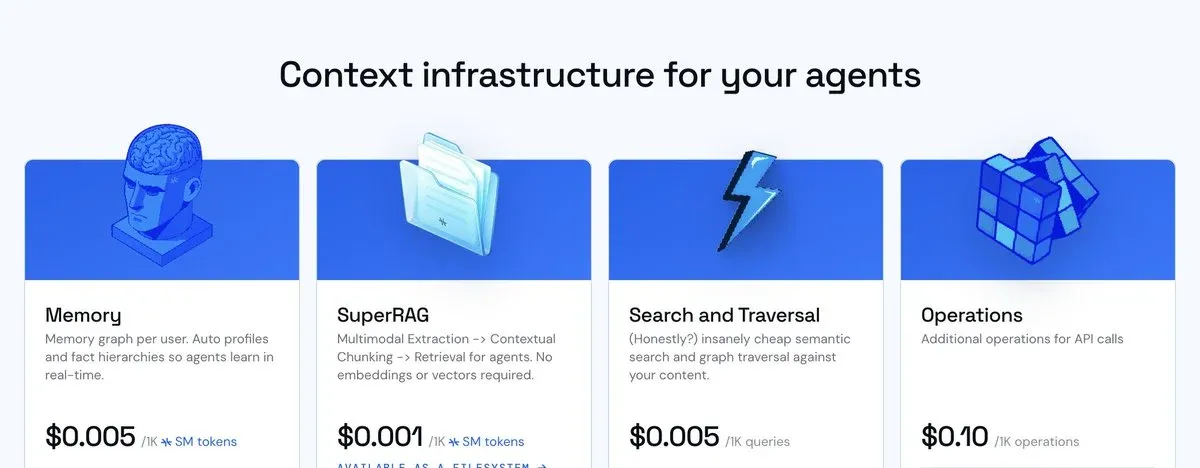
Supermemory pricing cards: Memory $0.005, SuperRAG $0.001, Search and Traversal $0.005, Operations $0.10 per 1K

Depending on how you count it, this makes Supermemory the cheapest memory layer on the market. yes, headline prices didn't move. The math underneath did. Most of you will pay less for the same workload starting next month, and some of you will pay significantly less.

And now, no matter what, our customers have the perfect breakdown of how much they spend.
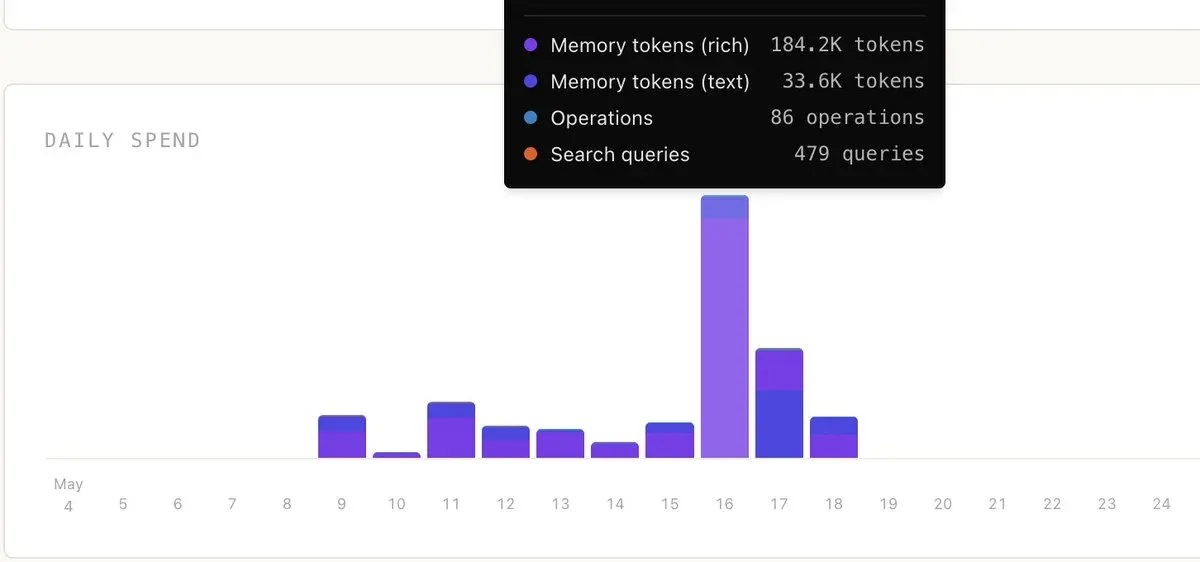
Daily spend bar chart with a tooltip showing 184.2K rich memory tokens, 33.6K text tokens, 86 operations and 479 queries

This, along with the launch of our filesystem (smfs.ai) marks the transition of supermemory moving from just a memory system to becoming the Context Cloud.

The legos to build your agents, the way they should be. And we provide the best, most reliable, and delightful infrastructure components that doesn't break your bank while helps you build and ship fast.

We're ready for the next chapter. are you?

  1. SMFS: making agentic retrieval 55% cheaper AND more accurateWe launched SMFS.ai (Supermemory Filesystem) a few weeks ago, with a simple bet: We can redesign the filesystem specifically for agents, with special files, structures, and commands that it can use for it's tasks. Today, SMFS is used by hundreds of companies to power their agents.
  2. Introducing Dynamic Dreaming: supermemory now connects the dots, for you.Dreaming is magical. TLDR: We're launching Dynamic Dreaming in supermemory today, which automatically works if you're using supermemory in any way - API, OpenClaw, Hermes agent, etc.
  3. Introducing @supermemory/tools v2.0.0Today we're releasing v2.0.0. This release unifies the API across all agents sdk integrations from AI SDK to Mastra, makes conversation identity a first-class concept, and ships with memory saving on by default.
  4. supermemory will make your Hermes-agent crazy powerfulToday, we are launching supermemory support to your Hermes agent TLDR: you can use supermemory now in your Hermes agent, it totally free to get started - https://supermemory.ai/docs/integrations/hermes In case you missed it: Hermes Agent is a self-improving AI agent from Nous Research.
  5. Solving the Precision-Recall Tradeoff: Search Result AggregationWhen you're building memory for AI, search is your foundational layer. The way search generally works is straightforward: the user defines a query, and then sets a limit (top-K) on how many search results they want returned. Usually, this is set to 10 or 20.
  6. Infinitely running stateful coding agentsWe built a plugin for Claude Code and OpenCode that gives your coding agent persistent memory. It remembers your preferences, learns your codebase, and never loses context mid-conversation. The result is an agent you can run for months without starting over.
  7. Why everyone is complaining about OpenClaw's memory (it sucks) - and why supermemory fixes it.TLDR: Today, we are releasing a new version of our openclaw plugin - https://github.com/supermemoryai/openclaw-supermemory. This post is going to be a bit technical, so bear with me (or bookmark for later!) In this post, I will talk about what we do about OpenClaw memory, and how we fix it.
  8. We added supermemory to Claude Code. It's INSANELY powerful now...Today, we are launching the Supermemory plugin for Claude Code! TLDR: You can use supermemory in claude code now. - https://github.com/supermemoryai/claude-supermemory Claude code has genuinely changed how I work. But there's this one thing that drives me crazy...
  9. Clawd / Molt bot's memory SUCKS. We gave it supermemory.I'm the founder of supermemory. Clawd/Molt bot is blowing up right now, with many, many use cases. I set it up, too, and have been using it through telegram. TLDR: just go to https://supermemory.ai/docs/integrations/clawdbot to set up supermemory for your clawd bot.
  10. Catch up with our UNFORGETTABLE Launch WeekOver the last year, one belief has guided almost everything we’ve built at Supermemory AI becomes meaningfully useful only when it remembers. Memory shouldn’t be something developers rebuild from scratch. It shouldn’t be fragile, expensive, or trapped inside a single tool.
  11. Empowering the Next Generation of Founders: Supermemory Startup ProgramIf there’s one thing we’ve learned while building Supermemory, it’s that most startups don’t fail because they didn't build features; they fail when infrastructure slows them down, or they built too slow.
  12. Building code-chunk: AST Aware Code ChunkingAt Supermemory, we're building context engineering infrastructure for AI. A huge part of that is dealing with code: ingesting repos, understanding structure, and making it searchable. The problem is that most code chunking solutions are terrible. We built code-chunk to fix this.
  13. Supermemory raises $3 million with the best memory engine for LLMsToday, I am excited to announce our first funding round to accelerate our mission of building an interoperable, scalable and reliable memory for LLMs and agents. Memory is one of the hardest challenges in AI right now.
  14. Unified Memory That Works Where You Work: Your Second Brain With SupermemoryHi everyone, I’m Dhravya, the founder of Supermemory. I want to start with a little story behind why this product means so much to me. You can also skip straight to what it is and how it works below.
  15. Supermemory just got faster on PlanetScaleWhat is Supermemory? Supermemory completes the missing part of the LLM puzzle: memory. Just as memory is crucial for human intelligence, it's essential for truly intelligent AI systems.
  16. Faster, smarter, reliable infinite chat: Supermemory IS context engineering.People are obsessed with prompts and prompt engineering. Sure, what you say is important, but what the model knows when you say it is the difference between a stateless text generator and an intelligent AI system. In short, context is the most crucial component.
  17. We solved AI API interoperabilityOne API to rule them all, One spec to find them, One library to bring them all and in the TypeScript, bind them. When we were building the the Infinite Chat API, initially, we only supported the OpenAI format. This was fine, until a lot of our customers started asking, asking for more.
  18. The UX and technicalities of awesome MCPsLast month, we launched the Supermemory MCP, mostly to test our own infrastructure and get some initial traction. It blew up. To my absolute surprise, the initial launch itself got half a million impressions (!!!). Then, we launched and got #2 on ProductHunt too.
  19. Architecting a memory engine inspired by the human brainLanguage is at the heart of intelligence, but what truly powers meaningful interaction is memory — the ability to accumulate, recall, and contextualize information over time. Large Language Models (LLMs) have mastered language, but memory remains their Achilles’ heel.