Blog·Case Study

The Wow Factor of Memory - How Flow Used Supermemory To Build Smarter, Stickier Products

By Dhravya Shah·5 min read

Supermemory header reading "Flow uses your notes to inform your writing" — Older notes and a current notebook share a band of warm light

Overview: Flow is a note-taking app built around a bold vision: to create a more personal, context-aware writing experience powered by AI. At the heart of this mission is memory. Flow uses Supermemory as a persistent memory layer, enabling users to ask questions about any of their notes, retrieve key information, and generate writing suggestions, even across different documents. It creates a note-taking experience that feels tailored, contextual, and deeply personal.
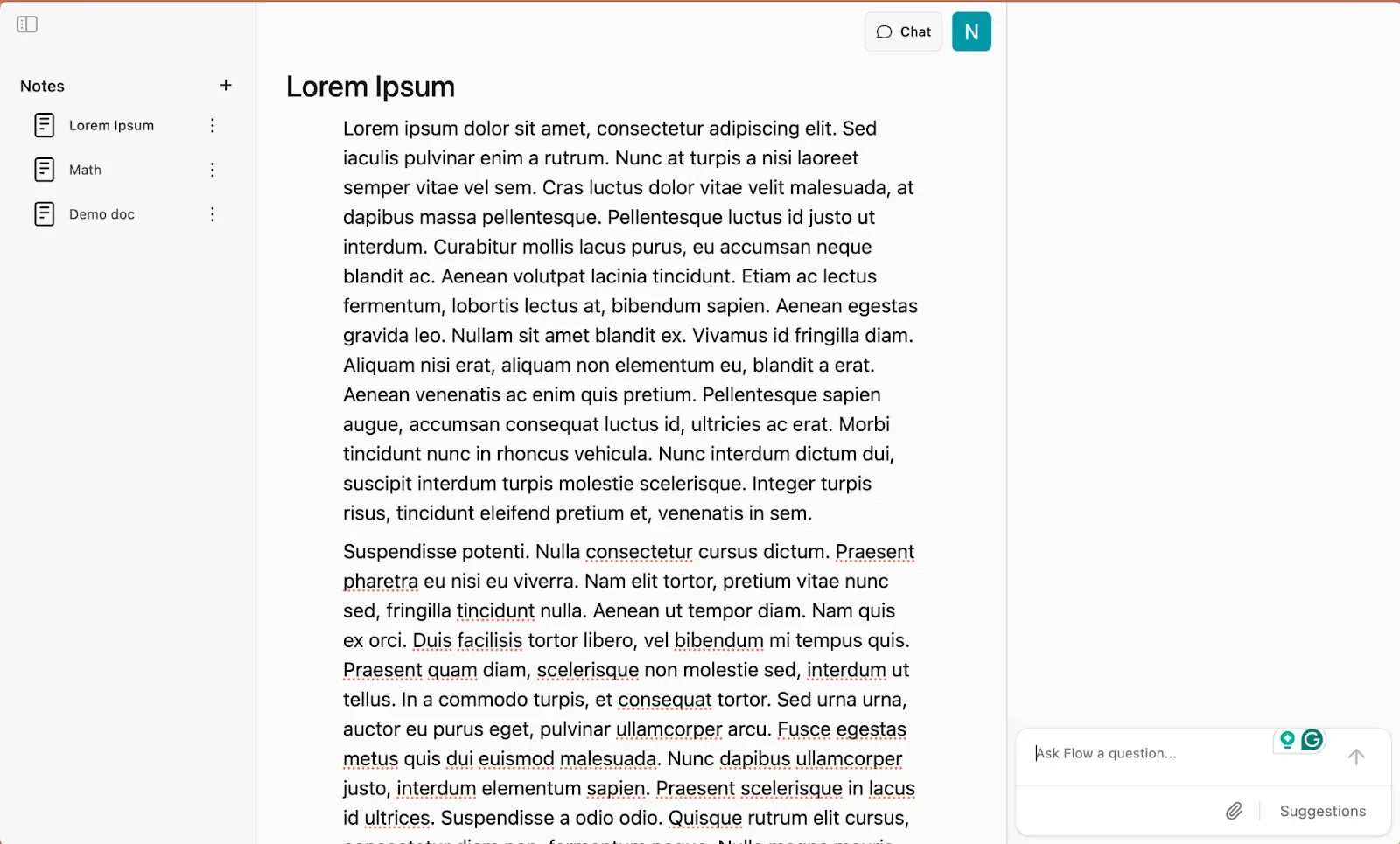
Flow app interface with a notes sidebar, a document editor showing placeholder text, and a chat panel on the right
Flow’s UI - Notes and Chat

There's a certain "time to wow moment" involved with every app. The higher it is, the higher users convert and use it more.
Supermemory brings this "Time to wow moment" down - When LLMs magically know everything about you, the experience is more natural, and product more delightful.


In this blog, we talk about how Flow uses supermemory to build better products, and how the "Wow factor of memory" is real.

When Daniel set out to build Flow, he knew memory would be at the core of his product.

“Having a good memory layer or like having some sort of remembering system, is what I always wanted… memory was the only important part for the product to go public.”

But actually getting that to work? Not easy.

Flow started out by integrating Mem0, a memory API that promised contextual recall. But it didn’t deliver. Daniel faced multiple issues:

  1. Existing memory tools couldn’t handle complex, high-volume input. Flow users were pasting full documents, and existing solutions broke down when large chunks of text were involved, making it difficult to build a seamless writing experience.
  2. Multi-document context was essential, and missing. Flow’s vision was to let users ask a question on one document and get an answer based on something they wrote somewhere else. That meant memory had to persist across documents, but existing systems lacked this capability. Daniel tried patching together solutions, but they just added latency, cost, and technical debt.
  3. API support was “poor”. No explanations needed there, really.

Daniel’s vision finally came into focus when he first stumbled upon the open-source project behind Supermemory, where people were using it to store and retrieve Twitter threads with simple prompts. That small use case sparked a bigger realization: what if Flow could give users the same kind of recall, not just within one note, but across everything they'd ever written?

He decided to integrate Supermemory. It took him one day to implement it, and instantly, things felt different.

  1. Flow could finally handle massive, messy, real-world context. With Supermemory, Flow’s customers could confidently pass large volumes of content like notes, PDFs, videos, and more, without breaking the experience. Everything just worked. This flexibility lets users bring their entire knowledge base into Flow, transforming it from a notes app to a second brain.
  2. A persistent memory layer that unlocked his product’s purpose. Supermemory’s memory API created a persistent, reliable memory layer that carried context across chats, across notes, across time. Now, users could reference something they wrote days or weeks ago, even in different documents, and Flow would instantly recall it. That was the “holy shit” moment.

“My users, they're like, ‘Oh wow! I can dump basically everything - videos, audios, images, etc. I would pay for this just because of how much context I can put in it!’, and Supermemory’s been the cornerstone behind helping us achieve that.”

  1. It’s the best support he’s ever seen. Daniel was one of the earliest builders to integrate Supermemory’s API, and that meant a lot of debugging in the early days. But he never felt alone. From schema design to integration questions, the Supermemory team was in the loop every day, helping him ship a reliable experience.

“Initially, it was a fair bit of debugging and calls, but with Supermemory, the support is the best I’ve ever seen.”

Vimeo content is paused until you allow embedded content.

Open on Vimeo ↗

With Supermemory, Flow became a better product and a better business. Daniel saw results both in the backend and in the way users engaged with Flow.

  • User retention hit 40%. Daniel’s favorite metric is “Users coming back for 3+ days consecutively”. Supermemory’s context layer helped make Flow feel sticky, and users kept returning to continue conversations. That sense of continuity drove Flow’s retention to 40%.
  • Lower token usage = significantly reduced infrastructure cost. With Supermemory handling persistent context, token usage dropped dramatically. Users stopped pasting long documents and context, and the AI stopped reprocessing what it already knew. For Daniel, that meant a noticeable dip in infra bills.
  • 60% reduction in backend requests. Instead of stringing together five different API calls for memory retrieval, user context, document fetching, embeddings, and response generation, Flow just needs to call Supermemory’s API, and everything gets done.

The day Daniel announced the Flow x Supermemory partnership, signups jumped by 50%. But, perhaps, the most meaningful outcome wasn’t a number.

It was a shift in Daniel’s confidence.

Supermemory made Flow feel robust, smart, and valuable, giving Daniel the confidence to start thinking about monetization.

“I’m considering changing the model to pay-first just because of how good the memory is.”

And maybe, that is the wow factor of memory. It benefits everyone involved - customers get a much better UX, your developers aren’t left scratching their heads, and founders can create real value.

Daniel didn’t have to change his product to fit the limits of memory. Supermemory finally met the bar he had always had in mind.

Want to build like Flow? Check out Supermemory’s docs and start building with memory today.

  1. We're open sourcing the company brain. Here's how we designed the multiplayer harnessCompany Brain is now open source. A walkthrough of the multiplayer harness behind its Slack experience, from proactivity and memory boundaries to approvals and recovery.
  2. Jev changes a lot in memory & context engineering. Here's exactly how.We tested Jev across reranking, chunking, observation, and harness decisions. Here is where fast decision models help memory systems, where they cost more, and where they still fall short.
  3. I reverse-engineered Instinct's memory. Here's exactly how it worksInstinct keeps its memory as git-tracked markdown files, found with grep rather than vectors. Here is the whole system as far as black-box probing can reconstruct it, and how to rebuild it on supermemory in about 60 lines.
  4. An update to supermemoryWe've discontinued the supermemory company brain and Nova. Everyone who was charged has been refunded, our MCP and plugins continue to run, and we're going all in on the memory engine.
  5. Scaling Conversations: How Adapta Grew Usage Without Losing ContextAdapta added Supermemory as a persistent memory layer so every conversation keeps its context — letting the team scale usage without losing the thread.
  6. How Chatarmin Ditched RAG and Went Memory-Only with SupermemoryChatarmin replaced a heavy RAG pipeline with Supermemory's memory layer — cutting average AI response time from 40s to 12s and token usage by 40–50%.
  7. SMFS: making agentic retrieval 55% cheaper AND more accurateWe launched SMFS.ai (Supermemory Filesystem) a few weeks ago, with a simple bet: We can redesign the filesystem specifically for agents, with special files, structures, and commands that it can use for it's tasks. Today, SMFS is used by hundreds of companies to power their agents.
  8. Introducing Dynamic Dreaming: supermemory now connects the dots, for you.Dreaming is magical. TLDR: We're launching Dynamic Dreaming in supermemory today, which automatically works if you're using supermemory in any way - API, OpenClaw, Hermes agent, etc.
  9. Dear reader, we just made supermemory insanely cheap... the Context CloudWhen I first started building supermemory, I had one goal: To build the best memory system for AI. I would talk to customers, and find out that memory was not the only thing they needed - They were all setting up 7-8 different vendors at the same time.
  10. Introducing @supermemory/tools v2.0.0Today we're releasing v2.0.0. This release unifies the API across all agents sdk integrations from AI SDK to Mastra, makes conversation identity a first-class concept, and ships with memory saving on by default.
  11. Solving the Precision-Recall Tradeoff: Search Result AggregationWhen you're building memory for AI, search is your foundational layer. The way search generally works is straightforward: the user defines a query, and then sets a limit (top-K) on how many search results they want returned. Usually, this is set to 10 or 20.
  12. OpenClaw Memory Problems: Why It Forgets and How to Fix It (2026)TLDR: Today, we are releasing a new version of our openclaw plugin - https://github.com/supermemoryai/openclaw-supermemory. This post is going to be a bit technical, so bear with me (or bookmark for later!) In this post, I will talk about what we do about OpenClaw memory, and how we fix it.
  13. Stateful Coding Agents with Memory: Build Long-Running Agents (2026)We built a plugin for Claude Code and OpenCode that gives your coding agent persistent memory. It remembers your preferences, learns your codebase, and never loses context mid-conversation. The result is an agent you can run for months without starting over.
  14. Clawd / Molt bot's memory SUCKS. We gave it supermemory.I'm the founder of supermemory. Clawd/Molt bot is blowing up right now, with many, many use cases. I set it up, too, and have been using it through telegram. TLDR: just go to https://supermemory.ai/docs/integrations/clawdbot to set up supermemory for your clawd bot.
  15. Catch up with our UNFORGETTABLE Launch WeekOver the last year, one belief has guided almost everything we’ve built at Supermemory AI becomes meaningfully useful only when it remembers. Memory shouldn’t be something developers rebuild from scratch. It shouldn’t be fragile, expensive, or trapped inside a single tool.
  16. Empowering the Next Generation of Founders: Supermemory Startup ProgramIf there’s one thing we’ve learned while building Supermemory, it’s that most startups don’t fail because they didn't build features; they fail when infrastructure slows them down, or they built too slow.
  17. Building code-chunk: AST Aware Code ChunkingAt Supermemory, we're building context engineering infrastructure for AI. A huge part of that is dealing with code: ingesting repos, understanding structure, and making it searchable. The problem is that most code chunking solutions are terrible. We built code-chunk to fix this.
  18. Supermemory raises $3 million with the best memory engine for LLMsToday, I am excited to announce our first funding round to accelerate our mission of building an interoperable, scalable and reliable memory for LLMs and agents. Memory is one of the hardest challenges in AI right now.
  19. Mem0 vs Supermemory: Why Scira SwitchedScira AI moved its production memory layer from Mem0 to Supermemory. This is what failed, what improved, and how the team evaluated the two systems.
  20. Never Record Again: How Montra Uses Supermemory to Rethink Video CreationCampbell Baron, the founder of Montra, has been making videos since he was twelve. By thirteen, he was already doing brand work. Today, he’s betting on a very different future for creators: a world where recording is the exception, and most videos are generated from scratch.
  21. Unified Memory That Works Where You Work: Your Second Brain With SupermemoryHi everyone, I’m Dhravya, the founder of Supermemory. I want to start with a little story behind why this product means so much to me. You can also skip straight to what it is and how it works below.
  22. Supermemory just got faster on PlanetScaleWhat is Supermemory? Supermemory completes the missing part of the LLM puzzle: memory. Just as memory is crucial for human intelligence, it's essential for truly intelligent AI systems.
  23. Faster, smarter, reliable infinite chat: Supermemory IS context engineering.People are obsessed with prompts and prompt engineering. Sure, what you say is important, but what the model knows when you say it is the difference between a stateless text generator and an intelligent AI system. In short, context is the most crucial component.
  24. We solved AI API interoperabilityOne API to rule them all, One spec to find them, One library to bring them all and in the TypeScript, bind them. When we were building the Infinite Chat API, initially, we only supported the OpenAI format. This was fine, until a lot of our customers started asking for more.
  25. The UX and technicalities of awesome MCPsLast month, we launched the Supermemory MCP, mostly to test our own infrastructure and get some initial traction. It blew up. To my absolute surprise, the initial launch itself got half a million impressions (!!!). Then, we launched and got #2 on ProductHunt too.
  26. Architecting a memory engine inspired by the human brainLanguage is at the heart of intelligence, but what truly powers meaningful interaction is memory — the ability to accumulate, recall, and contextualize information over time. Large Language Models (LLMs) have mastered language, but memory remains their Achilles’ heel.
YOUR PRIVACY

Change or withdraw any time via Cookie settings in the footer. Read our cookie notice.