Blog·Engineering

Solving the Precision-Recall Tradeoff: Search Result Aggregation

By Soham Daga·3 min read

Supermemory banner with "reranking" struck through above "aggregation," beside a blue robotic arm and chip

When you're building memory for AI, search is your foundational layer. The way search generally works is straightforward: the user defines a query, and then sets a limit (top-K) on how many search results they want returned. Usually, this is set to 10 or 20.

Once the request hits the server, a response is returned sorted by semantic similarity. More often than not, this basic semantic match answers the query decently well.

However, there's a catch.

Semantic search fundamentally struggles with precision. Because it's just matching vector proximity, there's often noise in those top results. Just because a document uses similar words doesn't mean it actually has the context to answer the user's question.

The Problem with Re-ranking

To solve this precision issue, the industry introduced re-ranking. What re-ranking does is add a reasoning step—usually through a cross-encoder model or an LLM—to pass over the retrieved data and select what would actually be the best match to the query.

Re-ranking is fantastic for precision. It guarantees that the documents returned are highly relevant. But it suffers from a massive flaw: Recall.

You are still constrained by your search limit. If your limit is set to 3, but answering the user's question completely requires pulling context from 5 different documents, you are stuck. You simply do not have enough "slots" to fit the complete answer into the context window.

And if you're using an LLM anyways, might as well do the entire reasoning and only give the LLM what it needs.

The Supermemory Approach: Aggregation

We built Aggregation to solve exactly this issue.

What aggregation does is look at the same corpus of data, and it respects the exact same result limit. However, instead of one slot equalling one literal document, each result slot is a synthesis of multiple documents condensed into one.

By condensing multiple relevant memories to take up only one search result space, you no longer have to choose between precision and recall. You get both.

Seeing it in Action

Let's look at how this actually works within Supermemory. Imagine a memory space containing a bunch of unstructured data about our team and what we do.
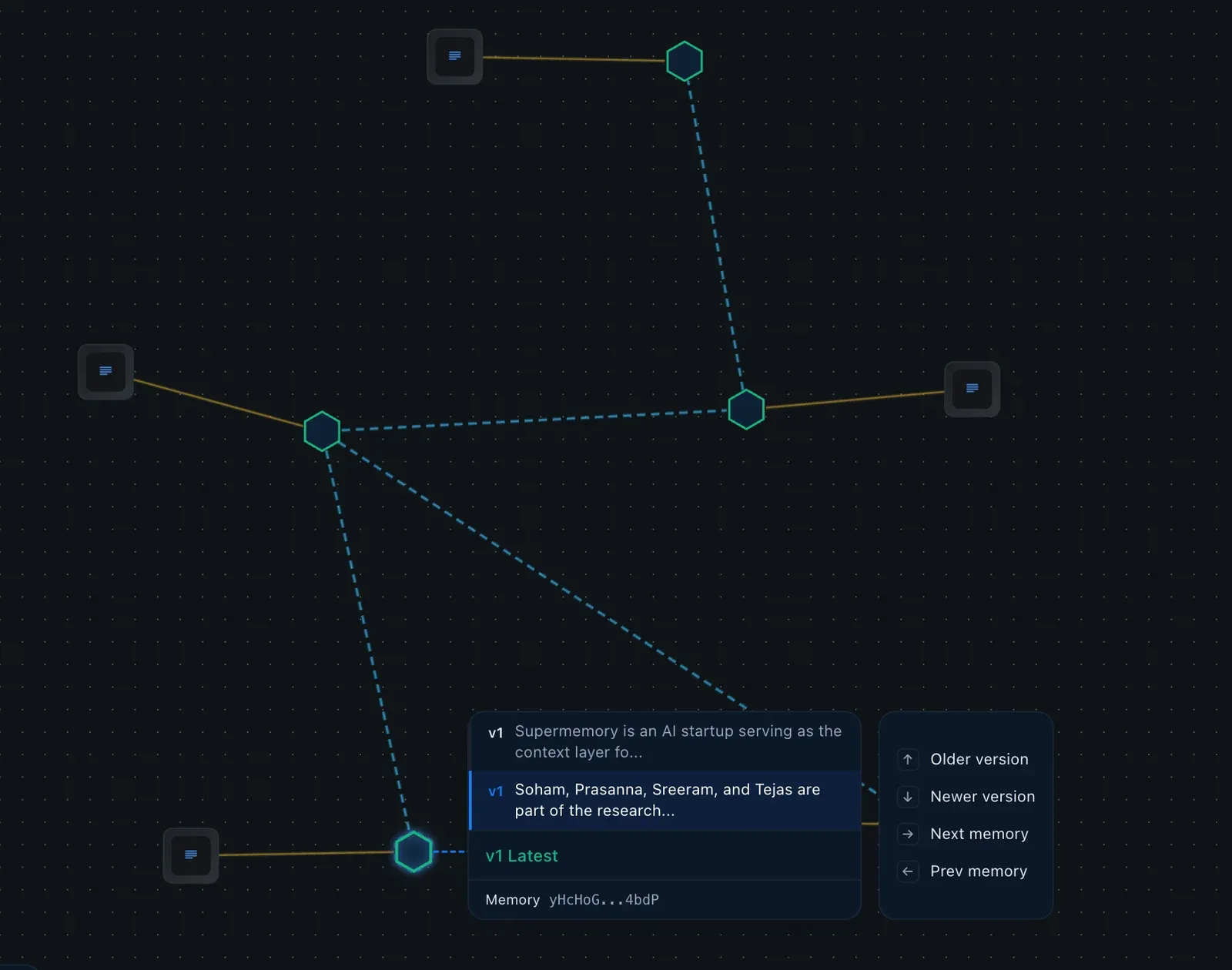
Memory graph of hexagonal nodes linked to documents, with a version popup showing v1 memory entries and navigation

We want to ask a complex, multi-session query: "What is Supermemory and who is behind it?"

To illustrate the point, we'll set our search limit to just 2.

Without Aggregation: When we run this standard search, it returns two memories. These memories might match part of the question fairly well, but there just aren't enough slots to completely answer both parts of the question. The limit of 2 bottlenecks the recall, leaving the LLM with an incomplete picture.

───────────────────────────────────────────────────────────────────────
id: RbqTQjS85K88weNqZbAPzu
memory: Dhravya is the founder and CEO of Supermemory
similarity: 0.77
───────────────────────────────────────────────────────────────────────

───────────────────────────────────────────────────────────────────────
id: yHcHoGPpacSsMYxiKH4bdP
memory: Soham, Prasanna, Sreeram, and Tejas are part of the research team at Supermemory
similarity: 0.75
───────────────────────────────────────────────────────────────────────

With Aggregation: Now, we turn aggregate to true and run the exact same query with the same limit of 2.

It still returns exactly two results—but these results are aggregated from multiple underlying memories.

───────────────────────────────────────────────────────────────────────
id: aggregated_0_1775529845474
memory: Supermemory is an AI startup positioned as the context layer for the agentic era, founded by its CEO, Dhravya.
similarity: 1.00
───────────────────────────────────────────────────────────────────────

───────────────────────────────────────────────────────────────────────
id: aggregated_1_1775529845474
memory: The team behind Supermemory includes members across various functions: the research team consists of Soham, Prasanna, Sreeram, and Tejas; Mahesh serves as an engineer, and Shardul is part of the growth team.
similarity: 0.90
───────────────────────────────────────────────────────────────────────
  1. Result 1 perfectly synthesizes multiple documents to answer the "What is Supermemory?" part of the query.
  2. Result 2 aggregates entirely different memories to completely answer the "Who is behind it?" part.

Why this matters for your LLM apps

This feature is incredibly powerful for multi-session use cases. It allows developers to maintain a very small search limit—keeping downstream LLM token usage low, less reasoning effort, and latencies lightning fast—while still achieving the ridiculously high recall and precision required to answer complex questions.

You can simply turn on

aggregate: true

In the supermemory API to get started.

It's a huge step forward in building a memory engine that actually scales with human complexity.

If you want better memory for your LLMs and apps, you can use this today. Check out our docs, and get an API key on our dashboard.

  1. An update to supermemoryWe've discontinued the supermemory company brain and Nova. Everyone who was charged has been refunded, our MCP and plugins continue to run, and we're going all in on the memory engine.
  2. SMFS: making agentic retrieval 55% cheaper AND more accurateWe launched SMFS.ai (Supermemory Filesystem) a few weeks ago, with a simple bet: We can redesign the filesystem specifically for agents, with special files, structures, and commands that it can use for it's tasks. Today, SMFS is used by hundreds of companies to power their agents.
  3. Introducing Dynamic Dreaming: supermemory now connects the dots, for you.Dreaming is magical. TLDR: We're launching Dynamic Dreaming in supermemory today, which automatically works if you're using supermemory in any way - API, OpenClaw, Hermes agent, etc.
  4. Dear reader, we just made supermemory insanely cheap... the Context CloudWhen I first started building supermemory, I had one goal: To build the best memory system for AI. I would talk to customers, and find out that memory was not the only thing they needed - They were all setting up 7-8 different vendors at the same time.
  5. Introducing @supermemory/tools v2.0.0Today we're releasing v2.0.0. This release unifies the API across all agents sdk integrations from AI SDK to Mastra, makes conversation identity a first-class concept, and ships with memory saving on by default.
  6. supermemory will make your Hermes-agent crazy powerfulToday, we are launching supermemory support to your Hermes agent TLDR: you can use supermemory now in your Hermes agent, it totally free to get started - https://supermemory.ai/docs/integrations/hermes In case you missed it: Hermes Agent is a self-improving AI agent from Nous Research.
  7. Infinitely running stateful coding agentsWe built a plugin for Claude Code and OpenCode that gives your coding agent persistent memory. It remembers your preferences, learns your codebase, and never loses context mid-conversation. The result is an agent you can run for months without starting over.
  8. Why everyone is complaining about OpenClaw's memory (it sucks) - and why supermemory fixes it.TLDR: Today, we are releasing a new version of our openclaw plugin - https://github.com/supermemoryai/openclaw-supermemory. This post is going to be a bit technical, so bear with me (or bookmark for later!) In this post, I will talk about what we do about OpenClaw memory, and how we fix it.
  9. We added supermemory to Claude Code. It's INSANELY powerful now...Today, we are launching the Supermemory plugin for Claude Code! TLDR: You can use supermemory in claude code now. - https://github.com/supermemoryai/claude-supermemory Claude code has genuinely changed how I work. But there's this one thing that drives me crazy...
  10. Clawd / Molt bot's memory SUCKS. We gave it supermemory.I'm the founder of supermemory. Clawd/Molt bot is blowing up right now, with many, many use cases. I set it up, too, and have been using it through telegram. TLDR: just go to https://supermemory.ai/docs/integrations/clawdbot to set up supermemory for your clawd bot.
  11. Catch up with our UNFORGETTABLE Launch WeekOver the last year, one belief has guided almost everything we’ve built at Supermemory AI becomes meaningfully useful only when it remembers. Memory shouldn’t be something developers rebuild from scratch. It shouldn’t be fragile, expensive, or trapped inside a single tool.
  12. Empowering the Next Generation of Founders: Supermemory Startup ProgramIf there’s one thing we’ve learned while building Supermemory, it’s that most startups don’t fail because they didn't build features; they fail when infrastructure slows them down, or they built too slow.
  13. Building code-chunk: AST Aware Code ChunkingAt Supermemory, we're building context engineering infrastructure for AI. A huge part of that is dealing with code: ingesting repos, understanding structure, and making it searchable. The problem is that most code chunking solutions are terrible. We built code-chunk to fix this.
  14. Supermemory raises $3 million with the best memory engine for LLMsToday, I am excited to announce our first funding round to accelerate our mission of building an interoperable, scalable and reliable memory for LLMs and agents. Memory is one of the hardest challenges in AI right now.
  15. Unified Memory That Works Where You Work: Your Second Brain With SupermemoryHi everyone, I’m Dhravya, the founder of Supermemory. I want to start with a little story behind why this product means so much to me. You can also skip straight to what it is and how it works below.
  16. Supermemory just got faster on PlanetScaleWhat is Supermemory? Supermemory completes the missing part of the LLM puzzle: memory. Just as memory is crucial for human intelligence, it's essential for truly intelligent AI systems.
  17. Faster, smarter, reliable infinite chat: Supermemory IS context engineering.People are obsessed with prompts and prompt engineering. Sure, what you say is important, but what the model knows when you say it is the difference between a stateless text generator and an intelligent AI system. In short, context is the most crucial component.
  18. We solved AI API interoperabilityOne API to rule them all, One spec to find them, One library to bring them all and in the TypeScript, bind them. When we were building the the Infinite Chat API, initially, we only supported the OpenAI format. This was fine, until a lot of our customers started asking, asking for more.
  19. The UX and technicalities of awesome MCPsLast month, we launched the Supermemory MCP, mostly to test our own infrastructure and get some initial traction. It blew up. To my absolute surprise, the initial launch itself got half a million impressions (!!!). Then, we launched and got #2 on ProductHunt too.
  20. Architecting a memory engine inspired by the human brainLanguage is at the heart of intelligence, but what truly powers meaningful interaction is memory — the ability to accumulate, recall, and contextualize information over time. Large Language Models (LLMs) have mastered language, but memory remains their Achilles’ heel.